Guide
How to market a bin cleaning business: the whole playbook
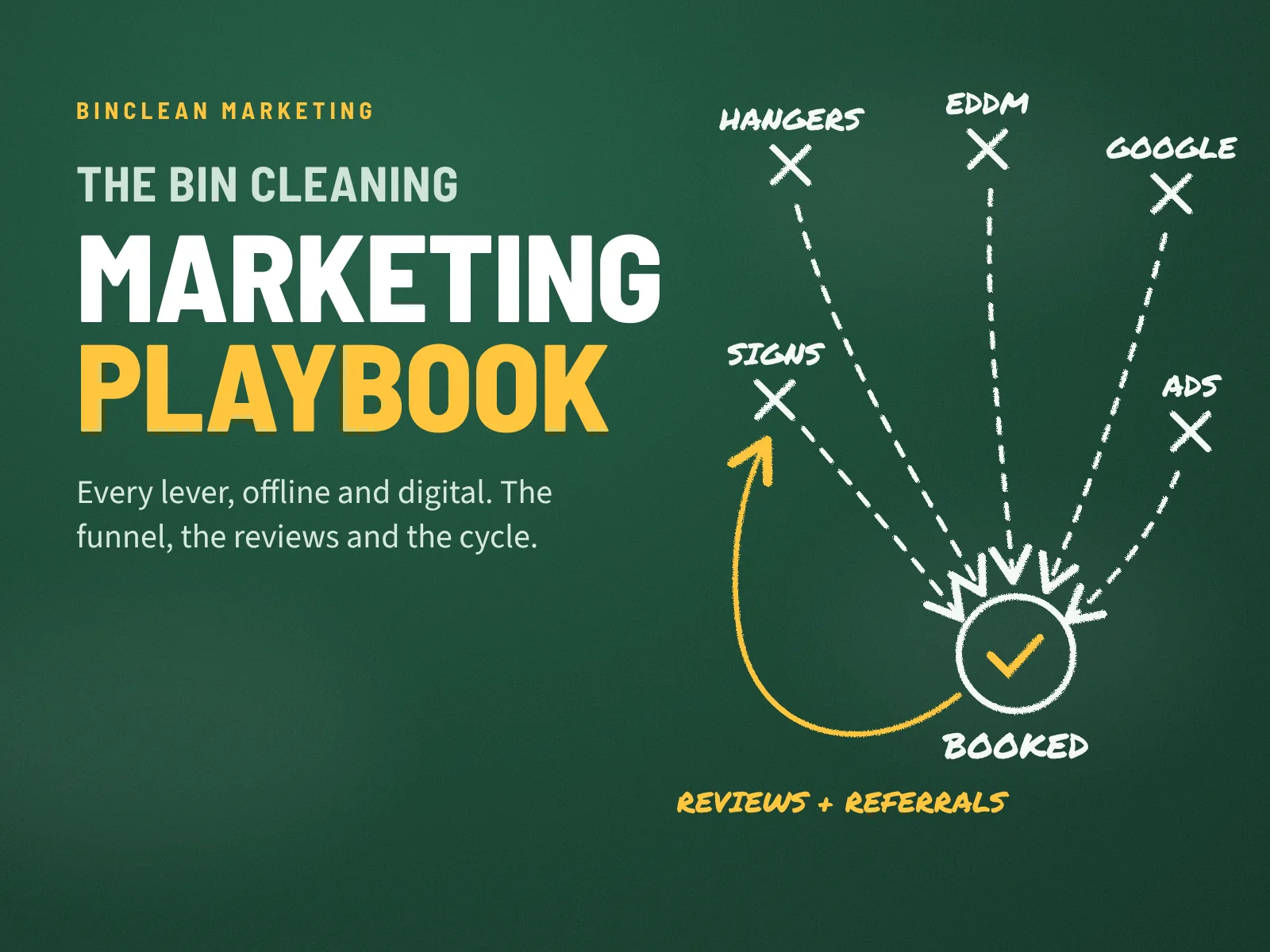
Read this first: what marketing is for
Most bin cleaning owners think marketing means flyers, Facebook posts and maybe some ads. Those are tools. Marketing is the whole system that takes a stranger to a paid, scheduled cleaning, and then keeps them paying for years.
That system has three jobs:
- Get customers. Make the right people in the right streets know you exist, trust you, and book.
- Keep customers. Bin cleaning is a subscription. The money is in month 6, month 18 and month 40, not the first cleaning.
- Get them close together. Ten customers on one street pay the same as ten across the county, but they cost a fraction to serve. Density is where the profit comes from.
Everything in this guide serves one of those three. If a tactic doesn't bring in customers you can serve profitably, help keep them, or fill a street you already drive, it's a distraction.
Here's what the system does when it works. Fresh Bins LA in the San Fernando Valley went from $3,000–6,000 a month to $10,000–14,000 a month, and from about 30 new customers a month to 70+. Google Ads cost them $41 per new paying customer, and those customers paid $117 on average on their first payment. None of that happened until the basics were in place: a complete Google profile, a website that shows prices and books, and booking and billing that run on their own. The full story is in the Fresh Bins LA case study.
- The fundamentals: the numbers that run the business, the funnel, why it has to book and run itself, why reviews fuel all of it, and the cycle that turns one customer into a street.
- Offline, every lever: your rig, cart stickers, door hangers, EDDM and mail, signs, door-to-door, flyers, HOAs, partners, events and commercial.
- Digital, every lever: Google Business Profile, your website, SEO, AI search, Google Ads, Facebook and Instagram, Nextdoor, groups, video, directories, email and text.
- Converting, keeping and referring: offers, retention, win-backs, upsells and referral programs.
- Running it: tracking, a plan for each stage of the business, the yearly calendar, the mistakes, and a one-page checklist.
Work through it on paper
Every part of this playbook has a fill-in worksheet in our free 32-page workbook. Print it and fill it in as you read.
Every number here is real and sourced: from our clients (Fresh Bins LA, South Bay Bin Cleaners and Zafra Trash Bin Cleaning), from our October 2026 research on 411 bin cleaning companies, from the free Clean Bin System startup course, or from the public sources linked in the text. Where we use example math, we say so.
The numbers that run the business
You can't judge any marketing until you know what a customer is worth and what you can afford to pay for one. Five numbers decide everything.
1. What a customer pays you
The median bin cleaner charges $25 a month for the first bin on a monthly plan, $36 per quarterly clean and $50 for a one-time clean, with extra bins usually $5 to $10 (our price data, 335 websites, October 2026). Most homes have two or three carts. At median prices, the startup course works out what a two-bin home pays:
| Plan | Per visit | Per year |
|---|---|---|
| Monthly | $29 | $348 |
| Every other month | $36 | $216 |
| Quarterly | $40 | $160 |
Source: How much money can a bin cleaning business make? A monthly customer is worth more than twice a quarterly one. That's why your offers, your website and your follow-ups should push people toward monthly.
2. How long they stay
This is the number most owners never look at, and it matters as much as price. If 3% of your customers leave each month, the average customer stays about 33 months (1 ÷ 0.03). If 5% leave, about 20 months. The course's likely case uses 3% and its careful case 5%.
3. What a customer is worth over their life
Multiply monthly revenue by months stayed. Example math, using the course's likely-case average of $23.43 a customer a month (a mix of monthly, every-other-month and quarterly plans):
| Customers leaving each month | Average stay | Revenue per customer |
|---|---|---|
| 2% | 50 months | about $1,170 |
| 3% | 33 months | about $780 |
| 5% | 20 months | about $470 |
| 8% | 12.5 months | about $290 |
Same prices, same service. The business that keeps customers can afford to spend three or four times as much to win each one, and still make more. That's why "keeping customers" is half of this guide.
4. What it costs to win one
Cost to win a customer is what you spent on a channel divided by the paying customers it brought in. Not leads, not clicks: paying customers. Fresh Bins LA's Google Ads number is $41. A referral with Clean Bin System's default rewards costs about $36 (a $20 credit plus half off a $32 first cleaning). A door hanger campaign costs printing plus your hours on foot. Work it out per channel, because the cheapest channel is rarely the one you'd guess.
5. How close together they are
In the course's income model, the same hot-water trailer brings in about $1,480 a day when stops are 2 minutes apart and about $490 when they're 20 minutes apart: 48 stops a day against 16 (routes lesson). A customer three streets from your route is worth far more than one across town at the same price.
Put them together
The rule we use: a channel is working when a customer pays back what it cost to win them within the first one or two cleanings, in the areas you already serve. Fresh Bins LA's ads cost $41 per customer and brought back $117 on the first payment, so the ad paid for itself on the first cleaning and every cleaning after that was money the ad had already paid for. If a channel takes a year to pay back, it can still be fine, but only if your customers actually stay a year.
The funnel: how a stranger becomes a customer
Every customer goes through the same steps, whether they found you on a door hanger or on Google. Picture a funnel: lots of people at the top, fewer at each step, paying customers at the bottom. Your job is two things: put more of the right people in the top, and stop them leaking out on the way down.
Each step, and where people leak out
| Step | Where people leak out | The fix |
|---|---|---|
| 1. They see you | Nobody in the right streets knows you exist. Or they see you once and forget. | Show up where they already look and where they live: your rig, stickers on cleaned carts, hangers on the neighbors' doors, Google, mail to the routes you drive. Repeat it. |
| 2. They check you out | No Google profile, a handful of reviews, a Facebook page instead of a website, a site that looks abandoned. | A complete Google profile, a steady stream of real reviews, a real website with real photos. |
| 3. They decide | No prices, "call for a quote", no idea how it works, no proof it's worth it. | Prices per bin on the page, a simple how-it-works, before-and-after photos, reviews next to the Book button. |
| 4. They book and pay | A contact form, a phone call that goes to voicemail, a Facebook DM answered the next day, a checkout that asks for 15 things. | Online booking that checks the address, shows the plan and price, saves the card, and books the first cleaning on their trash day. Reminders for people who start and stop. |
| 5. First cleaning | The cart wasn't out. They forgot. The card failed. Nobody told them what happened. | A reminder the day before, an on-the-way text, a done text with a photo, automatic card retries. |
| 6. The loop | They cancel in month two, never leave a review, never tell a neighbor. | Reliable service, a review ask in the done text, a referral link with a reward, pauses instead of cancellations, win-backs for one-time customers. |
Why the funnel matters more than any single tactic
Every lever in this guide pours people into the top. The funnel decides how many come out the bottom, and how long they stay. A weak funnel makes every channel look like it doesn't work. A strong one makes every channel work better at the same time.
Example math. Say 1,000 people a month reach your website, from all your channels combined:
| Weak funnel | Strong funnel | |
|---|---|---|
| Visitors a month | 1,000 | 1,000 |
| Who sign up and pay | 3% (contact form, no prices) | 10% (prices, online booking, reminders) |
| New customers a month | 30 | 100 |
| Customers leaving each month | 8% (missed carts, failed cards, no pauses) | 3% (reminders, retries, pauses) |
| Customers after a year (starting from 0) | about 240 | about 1,020 |
Same traffic. More than four times the customers. For comparison, Fresh Bins LA's site turns 11.2% of its Google ad clicks into paying customers. Our arithmetic for the year-one row: each month's customers, minus the share that leaves each month.
That's why the order matters: build the funnel first, then fill it. Ads, mail and door hangers pointed at a funnel that leaks are money poured into a bucket with holes.
Why the funnel has to book and run itself
Steps 4 and 5 of the funnel are where a lot of bin cleaners lose people. In our research, about 1 in 4 bin cleaners had no way to book online at all. And they're the steps you can fix once and forget. Here's why booking and automation matter so much in this business specifically.
People shop at 9 PM
Someone notices the smell when they roll the cart out after dinner. They search, find you, and want it handled now. If your site says "call for a quote" or "send us a message", you're asking them to wait until tomorrow, and by tomorrow they've booked with whoever let them do it on the spot. Online booking captures them while they're motivated.
Bin cleaning runs on trash day
A cart can only be cleaned empty, right after pickup. So every customer's cleaning has to land on their trash day or the day after, in the right week, and move when a holiday moves pickup. Doing that by hand from texts and a calendar is where missed carts, wrong days and angry customers come from. A system that knows each customer's trash day books it right the first time.
Recurring money needs a card on file
Monthly and quarterly plans only work if you charge automatically. Chasing Venmo requests and invoices every month is how customers quietly drop off. And cards fail: they expire, hit limits, get replaced. Stripe's default retry schedule tries a failed payment up to 8 times within 2 weeks (Stripe), and a card-update link texted at the first failure recovers the rest. Without that, every expired card is a customer you lose without noticing.
Reminders keep customers
The single biggest cause of a bad experience is a cart that wasn't out. A text the day before ("leave your carts at the curb after pickup") prevents most of them. An on-the-way and a done text with a photo turn an invisible service into one people notice and value.
The system can do the follow-up you won't
You're on a route all day. You won't remember to text the person who started booking and stopped, or the one-time customer whose cart smells again 75 days later, or the neighbor outside your area who asked when you'll come to their town. Software can, every time.
What Clean Bin System does, as an example
We built Clean Bin System for exactly this, around trash day. It's what we connect our clients' websites and ads to. What it handles in the funnel:
| Funnel step | What runs on its own |
|---|---|
| Book and pay | Your own sign-up page: address check, plan, price, card. Every plan button on your website opens that exact plan. The first cleaning lands on the customer's trash day. |
| People who start and stop | The Leads page lists unfinished sign-ups and the step each reached. Reminders go out by email 20 minutes after someone stops, then at 24 and 72 hours, each linking back to where they left off. |
| Outside your area | People outside your zones are saved as leads. When you grow a zone to cover them, one click sends each a "now serving your area" message with a booking link. |
| At the curb | The driver app signs up a neighbor on the spot in five steps, card included, and can clean their carts before you leave the street. The sign-up is saved as "door to door" and credited to whoever made it. |
| First cleaning and every one after | Reminders, on-the-way and done texts, receipts. Holidays move cleanings when a hauler's schedule changes. |
| Billing | Charges before or after each cleaning, on a set day, or by invoice. Failed cards are retried and the customer gets an update-card link automatically. |
| Keeping customers | Customers skip, move or pause cleanings from their own account instead of canceling. Win-backs for one-time customers. |
| Growth | Referral rewards on by default ($20 credit for the customer, 50% off the friend's first cleaning), gift cards, coupons, QR codes tagged by where you print them, and reports on where customers come from. |
It costs $89 a month for one technician, $179 for up to four and $329 for unlimited, with every feature on every plan. More on how we set it up.
Whatever you use, check for these
You don't have to use our software. But whatever you use, it should do these things, or your funnel leaks:
- Online sign-up that shows prices and takes a card, without a phone call.
- Scheduling built around each customer's trash day and hauler holidays.
- Automatic charges, failed-card retries and an update-card link.
- Reminder, on-the-way and done texts from a registered number.
- Follow-up for people who start booking and stop.
- Self-service skips and pauses for customers.
- A required "How did you hear about us?" and source tracking from ads and QR codes.
- Referral rewards that credit the account automatically.
If you're running on a wall calendar, a spreadsheet and Venmo, fix this before you spend a dollar on anything else in this guide. Fresh Bins LA was on a wall calendar when we started. It's the reason their growth didn't bury them.
Reviews: the fuel for the whole machine
If the funnel is the engine, reviews are the fuel. They work at every step at once:
- Step 1, being seen. Google ranks local results on relevance, distance and prominence, and prominence includes your reviews (Google). More good reviews put you higher on the map, where most local customers pick who to call.
- Step 2, being checked out. When someone sees three bin cleaners on the map, the stars and the count are the first thing they compare. "5.0 (37)" beats "5.0 (4)" every time.
- Step 3, deciding. Real reviews next to your Book button answer "are these people legit?" faster than anything you could write about yourself.
- Every paid channel. Ads, mail and hangers all send people to look you up. Strong reviews turn more of those lookups into bookings, so every dollar works harder.
In our research on 411 bin cleaning companies, the ones with 100+ reviews were about ten times as likely to be running Google ads as the ones with under 30 (39% against 4%), and their websites were bigger: 92% had 10 or more pages, against 52% of the small companies. They charge the same median price, $25 a month. What they have is a review count that makes every other channel convert (the research).
Among companies in our list with a known Google review count, the middle one had about 41 reviews, a quarter had 11 or fewer, and 30% had 100 or more (startup course). If everyone in your town is under 30, a steady review habit can make you the obvious choice.
The review system
Reviews don't come from asking once in a while. They come from a system that asks every customer, at the right moment, in a way that takes 30 seconds.
- Ask after the first cleaning. That's when the difference is most obvious: they open a clean, fresh cart for the first time. Put the review link in the "done" text or email with the photo.
- Make it one tap. Use your direct Google review link (Ask for reviews on your Google dashboard). Don't make them search for you.
- Ask in person too. When a customer says thanks at the curb, say "it would really help us if you left a Google review. I'll text you the link."
- Ask every customer the same way. Not just the ones you think are happy.
- Reply to reviews, briefly and by name. Answer bad ones fast, calmly and once.
- Track it. Count new reviews each month against new customers. If 40 people started and 3 reviewed, the ask isn't happening or isn't easy enough.
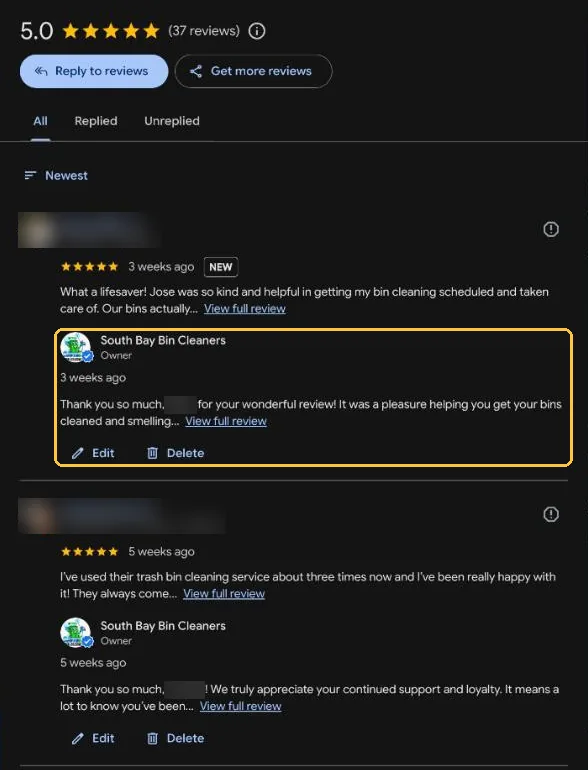
The rules (they're strict, and they're enforced)
- No rewards for reviews. Google doesn't allow offering money, discounts or free service in exchange for a review (Google Maps policy). "$5 off for a 5-star review" breaks the rules. So does a raffle for reviewers.
- No picking who you ask. Google bans selectively asking happy customers and discouraging negative reviews. Don't send a "how did we do?" survey and only pass the 5-star people to Google.
- No reviews from yourself, family or staff. The FTC's rule on fake reviews, announced in August 2024, bans fake reviews, buying reviews, incentives conditioned on a positive review, undisclosed reviews from insiders, and suppressing negative reviews with threats, and lets the FTC seek civil penalties (FTC).
- Don't ask for Yelp reviews at all. Yelp's guidelines say "Don't ask customers, mailing list subscribers, friends, family, or anyone else to review your business" (Search Engine Land). Claim your Yelp page, keep it accurate, and let reviews come on their own.
- Never put fake testimonials on your website. We've removed made-up reviews and stock photos from client sites during rebuilds. Link to your real Google reviews instead.
Bad reviews
You will get one. A cart gets missed, a lid cracks, a customer misunderstands the plan. What matters is the reply, because the next 100 people read it.
- Reply within a day or two. Thank them, say what happened plainly, say what you did about it.
- Offer to fix it: "We'll re-clean it free on your next trash day."
- Take details offline: "Text me at (number) and I'll make it right."
- Never argue, never share their personal details, and never offer something in exchange for removing it.
Photos from the driver app settle most disputes before they become reviews: a photo of the cart that wasn't at the curb answers "you skipped me".
The cycle: how one customer becomes a street
A funnel is how one person becomes a customer. The cycle is how that customer brings the next ones. This is the part of bin cleaning that most other businesses don't have: you do the work outside, at the curb, on the same day the whole street has its carts out.
Every time you clean a cart, the neighbors see your rig. If there's a sticker on the cart, they see your name every trash day after. If you hang a door hanger on the houses on each side, they get your price and a QR code the same afternoon. If the customer leaves a review and shares a referral link, you show up higher on Google and come recommended. And each new customer on that street makes the route denser, which makes every stop more profitable, which pays for more marketing.
That's why the cheapest customer you'll ever get lives next door to one you already have. Marketing's job is to start the cycle on a street. The work keeps it turning.
The route-day routine
Do this every route day. It costs almost nothing and it's how dense routes get built:
- Before you leave: load door hangers for the day's streets, a stack of business cards, and stickers.
- At each stop: clean the carts, put a sticker on each (where allowed, see below), take the done photo.
- Next door: hang a hanger on the houses on each side and across the street: "We just cleaned the carts at your neighbor's."
- If a neighbor walks over: answer, quote the price, and sign them up on the spot from your phone.
- After the stop: the done text goes out with the photo, the review link and the referral link.
- End of day: note which streets got hangers and which batch code they carried, so you can count what came back.
The yearly cycle
Demand follows the weather. Carts smell worst in summer, and in the North many bin cleaners slow down or stop from about November to March. Plan your marketing around it:
| When | What to do |
|---|---|
| January–February | Plan the year. Fix the website and Google profile. Order hangers, stickers and mail. Sell prepaid years. In warm states, keep routes full with commercial work and HOA common areas. |
| March–April | Spring launch: EDDM and hangers on your target routes, pre-sell new areas, restart paused customers, turn ads back up. "Spring clean your cans." |
| May–August | Peak demand. Ads at full budget on your best ZIP codes. Hangers on every route day. Maggot and smell season content. Push monthly plans. |
| September–October | Fill the routes you have. Ask for reviews from everyone who started in summer. Win-back texts to one-time summer customers. |
| November–December | Thanksgiving and holiday posts (more trash, smellier carts). Gift cards as presents. Check every hauler's holiday schedule and text customers before the week. Prepaid years for next season. |
Examples of how northern companies handle winter, from their own sites: MetroWash in Minnesota runs from about mid-April to mid-September, Magic Bin Cleaners in Connecticut runs April 15 to October and rolls unused cleanings to spring, and Bin Bros KC moves January and February cleanings to December and March (keeping-customers lesson).
Your name and your look
Every lever in this guide puts your name in front of someone. Make it one they remember and can find again.
- Be distinctive. Of the 411 company names in our research, 255 contain "bin", and names like "Bin Busters" and "The Can Man" repeat across states. A distinctive name is easier to remember, rank and protect. Put "trash can cleaning" in your headings, services and on your rig instead of in your name.
- Your Google name has to be your real name. Adding services or towns to your Google Business Profile name breaks Google's rules and can get the profile suspended. If you want "Trash Can Cleaning" in your Google name, make it your actual name, on your paperwork, rig and website.
- Check before you print: your state's business-name search, the free USPTO trademark search, the .com domain (about $11 a year), Facebook and Instagram handles, and Google Maps in your state.
- A logo that reads from 50 feet and works in one color. Canva's free plan costs nothing; a 99designs contest runs $249 to $1,050.
- The same look everywhere: rig, shirts, hangers, stickers, website, Google profile. When the mailer, the trailer and the website all match, people connect them, and the third time they see you, they book.
- Uniforms. A branded shirt makes you look like a business, not a stranger in someone's side yard, and it's on camera in every video you post.
From the startup course, October 2026.
Offline: every lever
Offline marketing is anything people see in the real world: on the street, on their door, in their mailbox, at an event, from a partner. For a bin cleaner it's often the best place to start, because your customers live in a few square miles and you're already driving those streets.
The rule for all of it: aim it at the streets you already serve, or the ones you're about to open. A hanger on a random street across town brings in a customer you can't serve profitably. A hanger next to an existing customer on cleaning day brings in a customer on a stop you're already making.
| Lever | Cost | Best for | How to count results |
|---|---|---|---|
| Wrapped rig, magnets | One-time | Being seen every route day, for years | "How did you hear about us?" |
| Cart stickers | Cents each | Reminding the whole street who cleans those carts | "How did you hear about us?" |
| Door hangers | Printing plus your time | Neighbors of current customers, on cleaning day | A QR code per batch |
| EDDM and mail | Postage plus printing | Every home on chosen mail routes, without a list | A QR code and offer per mailing |
| Yard signs | A few dollars each | A happy customer's lawn after a cleaning | A QR code on the sign |
| Door-to-door | Your time or a rep's | Streets around customers, signing up on the spot | Sign-ups credited to the rep |
| Flyers and cards | Cheap | Community boards, partners, leave-behinds | A QR code per placement |
| HOAs and street deals | A discount | Filling a whole street at once | Sign-ups from that neighborhood |
| Partners | A referral fee or swap | Realtors, property managers, pest control, pressure washers | A code or link per partner |
| Events and sponsorships | A booth or a donation | Faces and trust in a new area | A QR code per event |
Notice the last column. Offline marketing has a reputation for being unmeasurable. It isn't, if every piece carries its own QR code and every sign-up answers "How did you hear about us?" More on that in Measure what works.
Your truck or trailer
Your rig is the one ad that's on your best streets every single route day, parked in front of a customer's house while the whole street watches you work. It should sell for you.
- What goes on it: your name, "Trash Can Cleaning" (the words homeowners use), your website, your phone number and "Book online". A QR code on the back or side works for people walking by.
- Make it readable from 50 feet. Big, high-contrast letters. Your logo should work in one color.
- Wrap or magnets. A full wrap is usually a few thousand dollars, so get two or three local quotes. Magnets are a cheap start on a steel truck door, but many trailers aren't steel, so test with a fridge magnet first (startup course).
- Keep it clean. A filthy trailer selling cleanliness undoes the message.
- Park it where people see it. In the driveway at home (if your HOA allows), at a busy spot when you stop for lunch, outside the hardware store.
Cart stickers
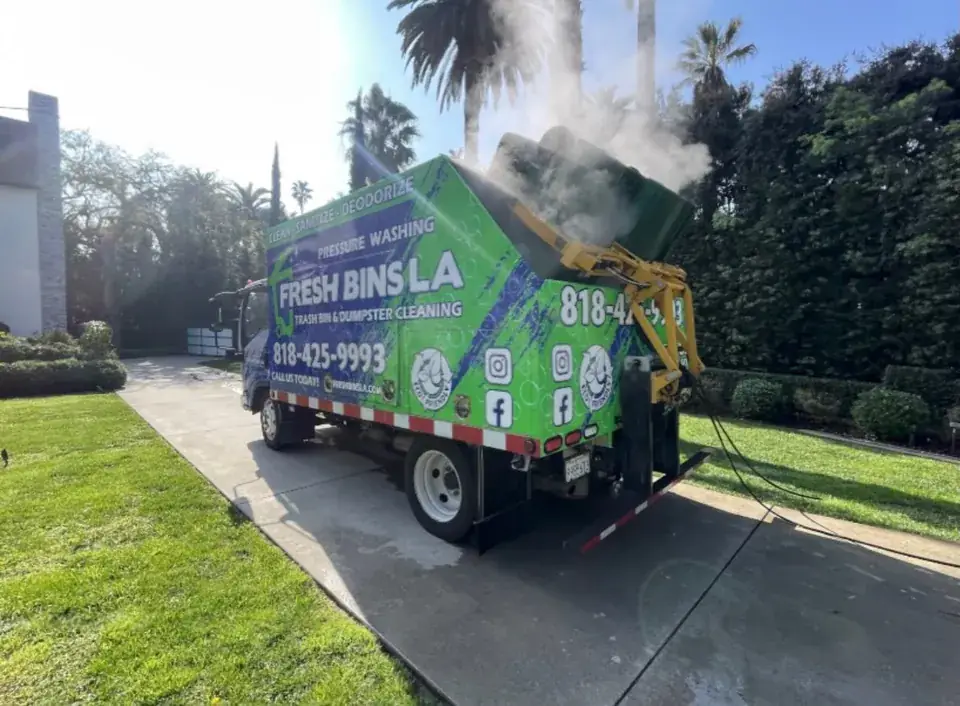
A small sticker on every cart you clean tells the whole street who did it, every trash day, for as long as it lasts. It's the cheapest repeating ad in the business. One North Carolina company's sticker tells the HOA the bins are professionally cleaned (startup course).
Check the rules first
In many cities the carts belong to the city or the trash hauler, not the homeowner. Fort Lauderdale, for one, says its carts are city property, asks residents not to paint them, and allows only the house number in a marked space on the lid, warning that other markings may cost the city to remove (City of Fort Lauderdale). Before you sticker anything:
- Check your city's or hauler's cart rules for each area you serve.
- Ask the customer, and offer to skip it if they'd rather not.
- Keep it small and removable, and never cover the cart's serial number, barcode, the city's labels or the house number.
- If stickers aren't allowed, use a hang tag on the handle after each cleaning instead ("Cleaned and sanitized today by…").
What to put on it
- "Cleaned by [Your Company]" and the date or month.
- Your website or a QR code.
- Nothing else. It has to be readable from the sidewalk.
Door hangers
Door hangers are the classic bin cleaning tactic, and they work best in one specific way: on the doors next to a customer you just cleaned, on cleaning day, while the rig is still on the street. Used that way, a hanger isn't cold advertising. It's "we were just at your neighbor's".
The honest math
There's almost no published data on door hangers for bin cleaning. One cleaning-business blog reported 100 hangers, about two hours of walking, three inquiries and two customers (Cleaning Business Academy). The startup course worked out what different response rates would mean for 100 customers:
| Homes that sign up | Hangers for 100 customers | Printing | Hours on foot |
|---|---|---|---|
| 0.5% | 20,000 | about $2,800 | about 400 |
| 1% | 10,000 | about $1,400 | about 200 |
| 2% | 5,000 | about $700 | about 100 |
Printing at UPrinting's $140 per 1,000 and about 50 hangers an hour, from the startup course (example math). The takeaway: blanketing a whole town is a slow road to 100 customers. Hangers on the neighbors of current customers, on cleaning day, are where they pay.
What to put on it
- The headline: "We just cleaned the carts at your neighbor's on [street]." Leave a blank to write the street.
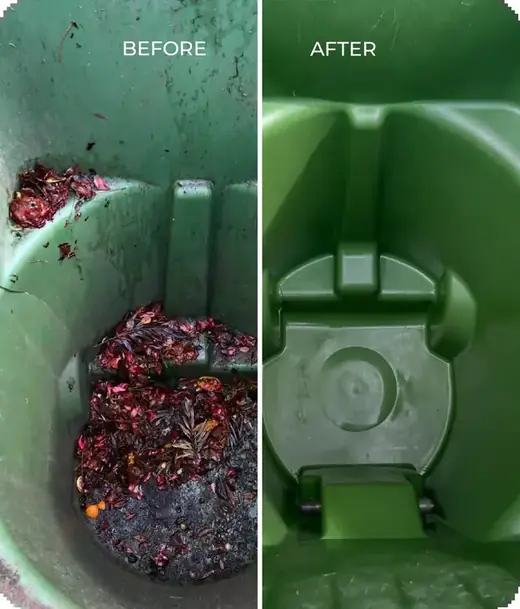
- A real before-and-after photo of the inside of a cart.
- Your price per bin and your plans. People decide on the doorstep.
- A QR code to your sign-up page, unique to that batch, so you can count what it brings in.
- Your phone number and website for people who won't scan.
- One reason to act now, if you have an honest one: "We're on your street every fourth Tuesday."
- A line from a real review, with the customer's permission.
The rules
- Never put anything in or on a mailbox. Federal law bars putting unstamped mail in a letterbox (18 U.S.C. 1725). Doorknobs only.
- Respect "No soliciting" signs.
- Check your city's and HOA's rules before you start. Some cities regulate door-to-door activity and some HOAs ban it.
- Don't litter. A hanger on the ground is a bad first impression. Hang it firmly on the knob.
EDDM and direct mail
Every Door Direct Mail (EDDM) is the U.S. Postal Service's way of mailing every address on a mail carrier's route without buying a list. For a bin cleaner, it's how you reach every home on the streets you want, without walking them.
How EDDM works
- No list, no stamps. Pieces are addressed to "Postal Customer" and go to every address on the routes you pick. A printed indicia replaces the stamp.
- Price: EDDM Retail postage is $0.26 a piece. Larger mailings through a business mail entry unit can be as low as $0.259 with a bulk permit (USPS).
- Volume: EDDM Retail takes 200 to 5,000 pieces per ZIP code per day.
- Size: it has to be a "flat", larger than a regular postcard. Check your design with the Mailpiece Size Checker in USPS's EDDM Online Tool before you print.
- Picking routes: the EDDM Online Tool shows each carrier route on a map with the number of residential addresses, and census data like age and income. Pick routes that are mostly single-family homes, near your current customers, ideally sharing their trash day.
Printing usually costs more than the postage, so get quotes from a printer that does EDDM. Many will bundle and deliver it to the post office for you.
Make the mailer work
- One message. "Trash can cleaning in [neighborhood]. $X a bin." Not a list of everything you do.
- The before-and-after big enough to read from across the kitchen.
- Prices, plans, and a QR code that opens your sign-up page with a campaign tag.
- An offer with a date, if you use one, and only for people who start a plan (more in Turning interest into a booking).
- Reviews: your star rating and count, and a line from a real review.
- Your trash-day hook: "We clean the day your carts are emptied. You don't need to be home."
Send it more than once
One mailing to a route is a test. People notice a business after they've seen it a few times, and a household that ignored you in April might need you in July when the cart smells. If you mail, plan two or three drops to the same routes over a season, and stop sending to routes that bring nothing back after the second.
Example math
Say you mail 2,000 homes on four routes next to your current customers. Postage at $0.26 is $520. Add printing. If 0.5% sign up, that's 10 customers. If they're two-bin monthly customers paying $29 a visit, that's $290 a month, so the mailing pays back within a few months, and you've added 10 stops to streets you already drive. If 0.1% sign up, that's 2 customers, and you'd want to change the piece, the offer or the routes before mailing again. Your own QR counts will tell you which it is.
Other mail
- New movers. Mailing list companies sell lists of new homeowners by ZIP code. A "welcome to the neighborhood, here's your first cleaning" postcard catches people setting up their household.
- Postcards to past customers and one-time customers, ahead of summer.
- HOA newsletters. Many HOAs print or email a newsletter. A short piece on why carts smell in summer, with your name on it, often costs nothing.
Yard signs, and the signs to avoid
Yard signs on customers' lawns
Ask a happy customer to keep a small yard sign on the lawn for a week after a cleaning: "Our carts are cleaned by [Your Company]." A neighbor's endorsement on a neighbor's lawn is worth more than any sign you could put up yourself. Yard signs start around $10.99 each at Vistaprint (Vistaprint). Check city and HOA sign rules, and pick them up when you said you would.
Don't use bandit signs
Signs stuck on telephone poles, in medians or along the road are called bandit signs, and many cities ban them in the public right-of-way. Riverside, California bans private signs on parkways, medians, streetlights, utility poles and other public property, removes them and can fine you (City of Riverside). Austin removes them and can fine repeat offenders up to $2,000 per sign (City of Austin). They also make your business look like a fly-by-night operation, which is the opposite of what you're selling.
Door-to-door
Knocking on doors is uncomfortable, slow, and for a bin cleaner, one of the most effective things you can do on the right streets. The right streets are the ones where you already have customers, on the day you're there cleaning.
When it works
- On route day, on the street you're cleaning, while the rig is running. People come out to see what the noise is. That's your opening.
- In the late afternoon and early evening and on weekends, when people are home, within the hours your city allows.
- In summer, when every cart on the street smells.
- When you can sign them up on the spot, on your phone, card and all. "I'll think about it" usually means no. "I can add you to Tuesday's route right now" usually means yes.
A simple script
"Hi, I'm [name] with [Company]. We're cleaning your neighbor's trash carts today, the [last name]s at number 14. We come the day after trash pickup, wash them with hot water, sanitize and deodorize, and you don't need to be home. It's $X a bin a month. Want me to do yours while I'm here?"
Then stop talking. Have a before-and-after on your phone. If they say yes, sign them up right there. If they say not now, leave a hanger with the batch QR code.
Sign up on the spot
Clean Bin System's driver app does this in five steps: address, plan, bins and trash day, their details, then their card. If you drive routes, "Clean now" adds them as a stop and you clean their carts before you leave the street. The sign-up is saved as "door to door" and credited to whoever made it, so you can pay a rep per sign-up and see exactly what door-to-door brings in. Tick the box for texts only when the customer says yes.
The rules
- Get the permit. Many cities require a solicitor or peddler permit for commercial door-to-door sales. Fort Collins, Colorado, for example, requires a city permit, photo ID badges for each solicitor, and allows soliciting only from 9 a.m. to sunset (City of Fort Collins). Call your city clerk.
- Respect "No soliciting" and "No trespassing" signs. In Fort Collins those signs prohibit all door-to-door solicitation, and residents can also join a no-solicitation list.
- Check HOA rules in gated or managed communities.
- Be easy to say no to. Thank them and move on. You'll be back on that street every month, and you want them to remember you as polite.
Hiring a door-to-door rep
Once you have a few routes, a part-time rep paid per sign-up can fill them faster than you can while you're cleaning. Pay on signed, paid customers, not on doors knocked. Clean Bin System lets sales reps sign up customers from the app without taking a technician spot, and tracks every sign-up they make.
Flyers and business cards
Flyers are the weakest offline lever on their own, but they're cheap and they fill gaps.
- Community boards: grocery stores, hardware stores, coffee shops, laundromats, libraries, gyms. Pin a flyer with tear-off tabs or a big QR code.
- Partner counters: a stack at the pest control office, the realtor's office, the HOA clubhouse.
- Leave-behinds: a business card with every quote, every commercial pitch, every conversation at the curb.
- Customers' fridges: a magnet with your number and "next cleaning: every 4th Tuesday" for new customers.
Same rules as hangers: never in or on a mailbox, never on windshields where it's banned, and a QR code per placement so you know which board actually brings people in.
HOAs, apartments and whole-street deals
One HOA deal can fill a street in a day. Ten homes on one street is ten stops for one drive, which is the best route economics there is.
Real offers from bin cleaners' own sites
- Magic Bin Cleaners (Connecticut): an HOA-only $40 cleaning for one or two bins, with a minimum of 18 homes, and marketing materials provided.
- Texas Scrub Hub (San Antonio): a Neighborhood Cleaning Day. The organizer shares a sign-up link and earns a free cleaning for every 10 neighbors who book.
- Texas Bin Works: a bulk rate for HOA-owned bins "because we will already be working in your community."
From the startup course, October 2026.
How to approach an HOA
- Find the management company. It's usually on the HOA's website or the sign at the entrance.
- Email the community manager. Keep it short: what you do, the group price, the minimum, that residents sign up and pay on their own.
- Offer something useful to the board: a group cleaning day, or a short newsletter piece on why carts smell in summer.
- Bring proof of insurance. Management companies often ask vendors for $1 million of liability cover with the HOA named as additional insured.
- Give them a sign-up link or QR code with a campaign name, so you can see every home that joins from that community.
Whole-street deals without an HOA
You don't need a board to do a street deal. Ask a happy customer to be the organizer: "If four of your neighbors sign up, your next three cleanings are free." Give them a referral link and a door hanger stack. Some of your best customers will enjoy being the one who got the street on board.
Apartments and property managers
Apartment communities, condos and rental managers have dumpsters, dumpster pads, trash rooms and sometimes resident carts. It's a different sale (one decision-maker, a quote, an invoice) but it's steady work that doesn't stop in winter. See Commercial work.
Partners
Partners are businesses that already talk to your customers. A good partnership sends you customers for years for the cost of a referral fee or a favor back.
| Partner | Why it works | What to offer |
|---|---|---|
| Realtors | Move-ins and move-outs need a one-time cleaning, and a gift card makes an easy closing gift. 20 of the 84 bin cleaner sites the course read sell gift cards. | Gift cards they can buy in bulk, or a referral fee per sign-up. |
| Property managers | Dumpsters, pads, trash rooms, and resident carts at rentals. | A commercial quote and a turnover cleaning price. |
| Pest control | Their customers already have the fly and roach problem. Dirty carts are part of it. | A co-branded flyer or a referral fee both ways. |
| Pressure washers | 45 of the 84 bin cleaner sites mention pressure washing. You can refer driveways; they can refer bins. | A straight referral swap. |
| Landscapers and pool services | They're on the same streets every week, often with the same customers. | A referral fee, or a flyer in their invoice. |
| Trash haulers | Some partner with bin cleaners on their routes. Some start their own bin cleaning, so be careful what you share. | A conversation, not a contract, at first. |
| Schools, teams and charities | One Ohio company keeps a week open for school and charity fundraisers. | A fundraiser: a share of each sign-up goes to the cause. |
Give every partner their own code or link so you know who sends what, and pay the referral fee fast. A partner who gets paid quickly keeps sending. Sources: the startup course.
Events, sponsorships and local media
- Farmers markets, HOA events, home shows, community days. Bring a clean cart and a dirty one. People stop for the gross one. Have a QR code and a tablet to sign people up at the table.
- Sponsorships. A youth sports team banner or a school event costs little and puts your name in front of the families in your area. Ask for a link from their website too, which helps your SEO.
- Local news and newsletters. "Local company cleans 1,000 trash cans a month" is a story for a neighborhood paper, a local blog or an HOA newsletter, especially in summer.
- Nonprofits and fundraisers. A fundraiser week, where a share of each sign-up goes to a school or charity, gets you shared by people who would never share an ad.
Every event gets its own QR code with a campaign name. If a farmers market brings in nothing after two tries, stop going.
Commercial work
Restaurants, apartment complexes, HOAs with common trash areas, office parks and schools have dumpsters, dumpster pads and trash rooms that need cleaning. It's a different kind of sale: one decision-maker, a site visit, a quote, often an invoice instead of a card. The work is bigger per stop and steadier through winter.
- Start with who you already pass. The restaurant at the end of your route, the apartment complex across from your customers.
- Talk to the right person: the general manager at a restaurant, the property or community manager at a complex.
- Bring photos and a simple price per dumpster or pad, per visit, with a schedule.
- Mind the water. Commercial pads put more grease and waste in your wastewater. Know your local rules before you quote.
The startup course has a full lesson: Commercial work: dumpsters, pads and HOAs.
Digital: every lever
Digital marketing is how people find you when they go looking, and how you stay in front of them until they're ready. For a bin cleaner, most of it comes down to Google, because that's where people go when the cart smells.
| Lever | Cost | Best for | How to count results |
|---|---|---|---|
| Google Business Profile | Free | Showing up on the map when people search | Performance: views, calls, website clicks |
| Reviews | Free | Winning the click against other bin cleaners | New reviews against new customers |
| Website | Build plus hosting | Turning visitors into paid sign-ups | Sign-ups by source |
| SEO and city pages | Your time or an agency | Ranking in each town you serve, for years | Search Console and sign-ups by page |
| AI search and ChatGPT | Free | Being the answer when people ask an AI | "How did you hear about us?" |
| Google Ads | Pay per click | People searching right now, in your best ZIP codes | Ad clicks matched to payments |
| Facebook and Instagram ads | Pay per view or click | Building demand around your routes | Ad clicks matched to payments |
| Nextdoor | Free, ads paid | Neighbor recommendations | "How did you hear about us?" |
| Facebook groups | Free | Local recommendation threads | "How did you hear about us?" |
| Video and social | Your time | Before-and-afters people share | Views, then sign-ups |
| Directories | Mostly free | Consistent listings, some leads | Leads per directory |
| Email and text | Your software | Keeping, upgrading and winning back customers | Bookings from each message |
Google Business Profile
If you do one digital thing, do this. Your Google Business Profile is what shows on the map when someone searches "trash can cleaning near me", and it's free.
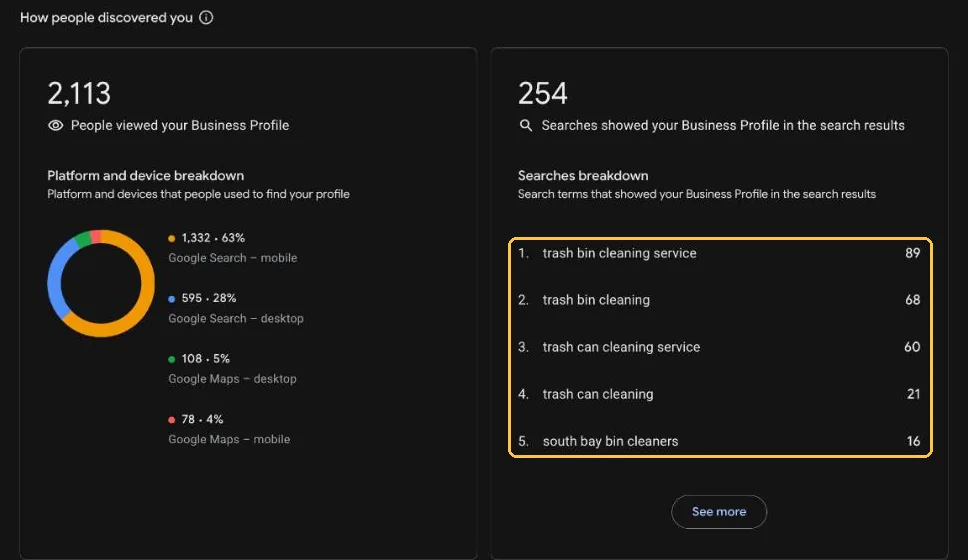
Here's what one does for a real bin cleaner. From June to early November 2026, 2,113 people viewed South Bay Bin Cleaners' profile, and that turned into 339 actions: 281 clicks to the website, 47 calls and 11 text chats. Of the 254 searches Google listed, only 16 were for the business's name. The rest were people searching for the service, like "trash bin cleaning service" (89) and "trash can cleaning service" (60).
The essentials:
- Set up as a service-area business, so your home address stays hidden.
- Pick Pressure washing service or Sanitation service as your main category. There's no bin cleaning category.
- Add your service areas, every service with a price, your hours, your booking link and a text number.
- Upload real photos and short videos. South Bay's two most-viewed items are videos, with 3.94K and 2.5K views.
- Post every week. Schedule a month at a time.
- Get a review from every customer, and reply to them.
The full walkthrough, with screenshots of every screen: How to set up your Google Business Profile.
Your website
Your website is the bottom of the funnel for almost every channel. The hanger, the mailer, the Google profile and the ad all send people there. In South Bay's numbers, about 83% of the actions people took on its Google profile were clicks to the website. If the website doesn't turn visitors into paid sign-ups, nothing else works as well as it should.
What it needs
- Prices on the page, per bin, per plan. 93% of bin cleaning websites we checked show prices, so a site that hides them is the odd one out (research).
- A Book button that goes straight to checkout, on every screen, pinned on phones. Each plan button should open that plan.
- "Trash can cleaning" in your title and main heading. In Fresh Bins LA's ads, searches with "trash can" converted at about 21% of clicks and plain "bin cleaning" at about 5% (keyword data).
- A page for each city you serve. Fresh Bins LA has 31.
- Real photos and real reviews. Your rig, your crew, your before-and-afters. A link to your Google reviews.
- A clear how-it-works and an FAQ.
- Fast on a phone. 63% of the people who viewed South Bay's Google profile were on a phone.
- Tracking that follows an ad click or a QR scan all the way to a payment. 21% of the bin cleaning sites we checked had no analytics or ad tracking at all.
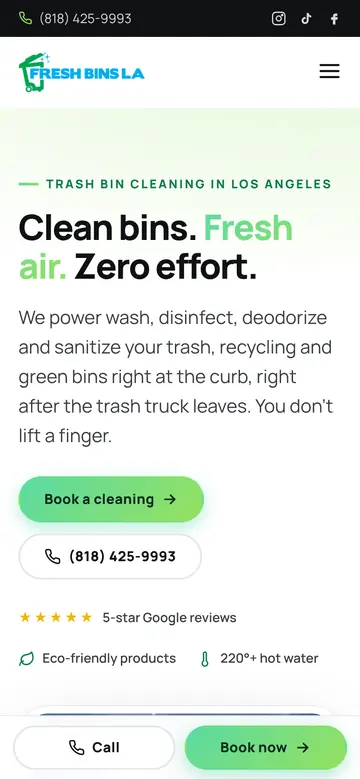
The full list is in the bin cleaning website checklist.
Don't run on a Facebook page alone
43 of the 411 companies in our research had no website at all, just a Facebook page or nothing. A Facebook page rarely ranks for "trash can cleaning near me" and can't take a recurring payment. A website with online booking does both.
SEO: showing up without paying for it
SEO is how your website ranks in Google's regular results, below the ads and the map. It's slow to build and free once it works, and it compounds: a city page that ranks this year still brings customers in three years.
City pages
People search with their town: "trash can cleaning Burbank". A single "service areas" page listing 30 towns doesn't rank for any of them. A page for each town you serve, titled the way people search ("Trash Can Cleaning in Burbank"), with real local detail (the trash day pattern, the neighborhoods, the hauler, a photo from that town), gives Google something to rank in each one.
In our research, 92% of the companies with 100+ reviews had websites with 10 or more pages, against 52% of companies with under 30. FAQ pages (65% against 31%) and blogs (45% against 12%) showed the same gap.
What else helps
- The right words: "trash can cleaning", "garbage can cleaning" and "trash bin cleaning" in titles, headings and services, with "bin cleaning" close by.
- Answer the questions people ask: how much it costs in your town, whether they need to be home, what happens if they miss trash day, how it's done.
- Local business schema: LocalBusiness, Service, FAQ and Breadcrumb structured data, so Google reads your details correctly.
- Consistent listings: the same name, phone and website on Google, Bing Places, Apple Business Connect, Yelp, Facebook, Nextdoor and the BBB.
- Local links: sponsorships, partners, chamber of commerce, local news. A link from your town's youth league counts more for local search than one from a random directory.
- Keep it current: new photos, updated prices, new city pages as you open zones.
Expect months, not weeks. Run Google Ads while SEO builds, then let SEO take over more of the work.
AI search and ChatGPT
Customers have started asking ChatGPT and other AI tools the same things they used to type into Google: "who cleans trash cans in Sherman Oaks?", "is bin cleaning worth it?". When those tools answer with local businesses, they pull from your website, your Google profile, your reviews and listings like ChatGPT's own.
- Claim your ChatGPT business listing. It's free and few bin cleaners have done it. Step by step: How to claim your ChatGPT business listing.
- Put prices in plain text on your website, not only in images. "How much does trash can cleaning cost" is one of the most common questions, and the business with a clear answer gets mentioned.
- Keep your details identical everywhere. AI tools cross-check sources.
- Don't block AI search crawlers in your website's robots.txt file if you want to be found there.
Google Ads
Google Ads put you at the top of the results for people searching right now. For bin cleaning, they're the fastest paid channel to work, because the people searching "trash can cleaning near me" want it done. But they only work once the funnel underneath is ready.
| Fresh Bins LA Google Ads, launch to Sep 30, 2026 | Result |
|---|---|
| Ad spend | $864 |
| New paying customers (matched in Stripe) | 21 |
| Ad cost per new paying customer | $41 |
| Average first payment | $117 |
| Ad clicks that became paying customers | 11.2% |
What made it work:
- The right words. "Trash can" searches converted about four times better than "bin cleaning". "Near me" and pricing searches converted at about 20%.
- The right ZIP codes. Three areas produced 27 of the first 29 conversions. The rest were cut and the budget moved.
- A strong negative keyword list: 128 terms blocking job seekers, DIY, people buying cans, people starting a bin cleaning business, and trash pickup.
- A landing page with prices and online booking. Send the same clicks to a page that converts 3% and each customer costs about $150 instead of $41.
- Counting payments, not Google's conversions. Google reported more conversions than Stripe showed paying customers. Budget decisions run off real payments.
Only 16% of the 411 bin cleaners we checked had Google ads running in October 2026 (67 companies). In most towns, the field is open.
The full breakdown, with the keywords, negatives and mistakes: Google Ads for bin cleaning.
Local Services Ads
Google's Local Services Ads (the pay-per-lead ads with a Google badge above the map) are open only to certain business categories, and the list changes. There's no bin cleaning category, so check Google's current list for your area before you plan around them, and don't count on them.
Facebook and Instagram ads
Facebook and Instagram ads reach people who aren't searching. That makes them weaker than Google for "I need this today" customers, and useful for building demand in the neighborhoods around your routes.
In our October 2026 research, 29 of the 411 bin cleaners (7%) had Facebook or Instagram ads running. The standard ad was a gross-out plus a discount: 28 of the 29 talked about smell, bugs or germs, and 10 offered 50% off the first cleaning. Seven used lead forms instead of sending people to book.
How to do it better than the standard ad
- Target tight. The ZIP codes and neighborhoods around your current routes, not a whole metro.
- Use your own video. A 15-second clip of a real cart going from gross to clean, shot on your phone, beats any stock image. Show your rig and your face.
- Lead with proof and price, not just disgust. Everyone else is already saying "maggots". Say "$X a bin, the day after trash pickup, 5.0 stars on Google."
- Send clicks to booking, not a lead form. A lead form gives you a name to chase. A booking page gives you a customer.
- Retarget website visitors. People who looked at your prices but didn't book are your warmest audience.
- Track to payments, the same as Google. Put the Meta tag on your site, carry the click into checkout, and judge by paying customers.
- Start small. A few hundred dollars over a few weeks on your best neighborhoods tells you what a customer costs. Only scale what pays back.
Nextdoor
Nextdoor is where neighbors ask "does anyone know someone who cleans trash cans?". The best Nextdoor marketing is a happy customer answering that thread with your name.
- The rule changed on August 19, 2026. Promoting a business on Nextdoor now has to come from a free Business Page, not a personal neighbor account. That covers posts, comments and unsolicited messages (Nextdoor). Older advice to post from your own account is now against the rules.
- Claim your free Business Page and post from it: before-and-afters, a summer tip, your new service area.
- Ask happy customers to recommend you on Nextdoor. Recommendations from neighbors are what people trust there.
- Nextdoor ads can be targeted by ZIP code, if you want to pay to reach a neighborhood you're opening.
Facebook groups
Every town has neighborhood Facebook groups, and they're full of recommendation requests. Each group's admins set the rules, and many limit business posts to a weekly thread or ban them.
- Read the rules and ask the admin if you're unsure.
- Post something worth reading in the allowed thread: a summer maggot tip, a before-and-after, a holiday schedule reminder. Not a flyer.
- Let customers tag you in recommendation threads. One "we use [Company], they're great" from a neighbor does more than a week of your own posts.
- Answer questions helpfully even when it's not a sale. People remember the business that explained how to keep their cart from smelling.
Video and social media
Bin cleaning is one of the most visual services there is. A cart going from black sludge to clean is the kind of thing people actually stop scrolling for, and it's free to shoot.
South Bay Bin Cleaners' two most-viewed items on its Google profile are videos, with 3.94K and 2.5K views, while most of its photos have a few hundred.
- Shoot on every route day: the inside of the dirtiest cart before, the wash, the result. 10 to 30 seconds. Vertical.
- Post the same clip everywhere: Instagram Reels, TikTok, YouTube Shorts, Facebook, and your Google profile.
- Show the people: you, your crew, your rig in your town. Local faces build trust.
- Use local words: the town, the neighborhood, "Tuesday trash day in Torrance".
- Answer common questions on camera: "Do you use my water?", "Do I need to be home?", "What do you do with the dirty water?"
- Don't chase followers. A post that gets 300 views in your service area beats one that gets 30,000 views across the country.
Directories and lead sites
- Bing Places and Apple Business Connect: free listings for Bing and Apple Maps. Copy your Google profile details exactly.
- Yelp: claim it, keep it accurate, add photos. Don't ask for Yelp reviews; Yelp's guidelines forbid it (see Reviews).
- Facebook page: keep the hours, prices and booking link current. Many people check it before they book.
- BBB and your chamber of commerce: trust signals and a local link.
- Thumbtack and Angi: lead sites where you pay for leads. Thumbtack has trash can cleaning pages in some cities, and bin cleaners also list under pressure washing. Track the cost per paying customer, not per lead, and compare it with your other channels before you keep paying.
Use the exact same business name, phone number and website on every one of them.
Email and text marketing
Your customer list is the cheapest audience you have. Email and text are how you keep them, upgrade them and win them back.
Messages worth sending
- Win-back: Fresh Bins LA texts and emails one-time customers 75 days after their cleaning, "right when the smell is coming back," inviting them to book again.
- Upgrade: "Your carts get cleaned every 12 weeks. Monthly keeps them fresh all summer for $X more."
- Extra bins and add-ons: recycling and green waste carts, driveway and patio pressure washing. The Trash Can Cleaners in San Antonio says emailing customers about pressure washing often books "thousands of extra dollars" (keeping-customers lesson).
- Seasonal: spring restart, summer smell season, holiday schedule changes, gift cards in December, prepaid years before spring.
- Referral reminders: "Your neighbors get 50% off their first cleaning with your link, and you get $20 off yours."
The rules
This is a summary, not legal advice. Service texts (reminders, on-the-way, done, card notices) are expected. Marketing texts (offers, win-backs, referral asks) are regulated:
- Written consent for marketing texts. Federal rules require "prior express written consent" for automated marketing texts (47 CFR 64.1200). In practice: an unchecked box at checkout for marketing texts, separate from service texts, that says what you'll send and that it isn't required to buy.
- STOP always works, and opt-outs must be honored quickly.
- Quiet hours: marketing texts only between 8 a.m. and 9 p.m. in the customer's time zone, stricter in some states. Sending between 9 a.m. and 8 p.m. is a safe habit.
- State laws: Florida allows damages per violation, and since September 1, 2025, Texas's telemarketing law covers texts (Morgan Lewis). Check your state.
- Register your texting number. Carriers block business texts from unregistered numbers. Bin cleaning software usually handles registration for you; start it before your first route.
- Marketing email: honest subject lines, your postal address, and an unsubscribe link you honor (FTC CAN-SPAM guide).
Turning interest into a booking
Everything above gets people to look. This is what gets them to book once they do.
Your offer
- Plans, per bin: monthly, quarterly (and maybe every other month), and one-time. Price one-time high enough that monthly looks like the deal. The median one-time price is about 2.3 times the monthly rate (price data).
- Discount only to start a plan. 50% off a one-time cleaning attracts one-time customers. "Half off your first cleaning when you start a monthly plan" attracts monthly ones.
- A founding offer when you open a new area: a locked price for customers who sign up before a date. Colorado Bin Squatch guaranteed founding customers' prices for five years; Hercules Bin Cleaning locks prices for 24 months for members who join by a deadline.
- A guarantee: "Not happy? Tell us within 24 hours with a photo and we'll re-clean it free on your next trash day." It costs little and removes the risk of trying you.
- Honest urgency only: "We're on your street every fourth Tuesday" or "founding prices until March 31". Never fake deadlines.
Your message
Nearly every bin cleaning ad says "gross, smelly, maggots" (28 of the 29 Facebook advertisers in our research). That's true, but it's not what makes someone pick you. Say what's different:
- Convenience: "We come the day after trash pickup. You don't need to be home."
- Price: the actual number per bin.
- Proof: your rating and review count, a real before-and-after, how many homes you clean in their town.
- Local: "Your neighbors on Elm Street use us."
Answer fast
Some people will call or text before they book. Answer during the day, reply to texts within the hour if you can, and when you can't, have your voicemail and auto-reply point to the booking link. A slow reply is a customer who booked someone else. And follow up the people who start booking and stop: Clean Bin System's Leads page shows them and reminds them three times on its own. Call anyone who got as far as the payment step.
Keeping customers
Go back to the numbers: at the same prices, a business losing 3% of customers a month gets about $780 from each one, and a business losing 8% gets about $290. Keeping customers is the cheapest growth there is. Most customers don't leave because of the cleaning. They leave through leaks:
| The leak | The fix |
|---|---|
| Cart wasn't out, so they got skipped or charged for nothing | A reminder text the day before every cleaning |
| They didn't notice the service | A done text with a photo after every cleaning |
| Card expired or declined | Automatic retries and an update-card link at the first failure |
| Going on vacation, or it's winter | Let them skip, move or pause from their own account. A paused customer comes back; a canceled one rarely does |
| Holiday moved trash day and you showed up on the wrong day | Check every hauler's holiday changes in November and December and text customers before the week |
| Something went wrong and nobody fixed it | Re-clean first, refund second, credit the account rather than the card when you can |
| They signed up monthly and canceled in month two | A minimum term stated clearly at checkout, or a prepaid year at a discount |
| One-time customers never came back | A win-back at 75 days |
Terms: pick one and say it plainly
Fresh Bins LA added a 12-month term to monthly and quarterly plans because people were signing up monthly and canceling in month two. The early-cancel charge is spelled out on the pricing page, in the FAQ, in the terms and in the welcome email. Zafra went the other way: no contracts, as a selling point. Both can work. 14% of the bin cleaning sites the course read offer a prepaid year, and Ameri-CANZ takes 20% off for paying up front (keeping-customers lesson).
Grow what each customer pays
- Extra bins. Most homes have two or three carts. Ask about the recycling and green waste carts at the first cleaning.
- Up the plan ladder. A quarterly customer who moves to monthly is worth more than twice as much.
- Add-ons: driveway and patio pressure washing, dumpster pads, trash valet (rolling carts to and from the curb).
- When you raise prices, keep current customers at their rate and charge new customers the new price. More in how to price bin cleaning.
Referrals
A referred customer comes in already trusting you, usually lives near the person who referred them, and tends to stay. It's the best customer you can get, and a good program makes it automatic.
| Company | Referral reward |
|---|---|
| Bin Scrub (IN) | A free cleaning for each new subscriber, no limit |
| Bin Bros KC (MO) | Both people get a free cleaning |
| Brite Bin (Denver) | $75 per referral |
| Hercules Bin Cleaning (VA) | A free cleaning credit, from a link in the customer portal |
| MD Clean (MD) | $5 account credit per referral |
| A Knightly Shine (FL) | A free cleaning for every 5 referrals |
From each company's website, October 2026, via the startup course.
What works
- Reward both people. The friend gets a reason to start; your customer gets a reason to share.
- Reward plans, not one-time cleanings.
- Credit the account automatically. A reward the customer has to ask for doesn't feel like a reward.
- Ask right after a cleaning, and put the link in every done text.
- Make sharing one tap: a link and a ready-made text.
- Never tie a reward to a review. Referral rewards are fine; review rewards break Google's rules and the FTC's.
Clean Bin System has this on by default: each customer gets a link and a code in their account, the friend gets 50% off their first cleaning, and your customer gets a $20 credit once the friend pays. With a $32 first cleaning, that's $36 to win a customer someone already vouched for, against Fresh Bins LA's $41 from Google Ads.
Measure what works
Every lever in this guide costs money or time. The only way to know which ones to keep is to count paying customers by source, every month.
How to know where customers came from
- Make "How did you hear about us?" required at sign-up, with simple choices: Google search, Google Maps, a neighbor, door hanger, mailer, truck, Facebook, Nextdoor, other.
- A QR code per print run, tagged with where it was printed and a campaign name ("hangers-elm-st-june", "eddm-spring"). Clean Bin System's QR codes page does this, and its reports count sign-ups by code.
- Tracking tags on links: your Google profile's website link, social bios and partner links, so analytics shows where visits came from.
- Ad tracking that reaches checkout, so every Google or Meta ad click can be matched to a payment.
- A separate number or code per partner.
The monthly scorecard
Once a month, write these down. It takes 20 minutes and it's the most useful marketing hour of the month:
| Number | Where to find it |
|---|---|
| New paying customers, by source | Your booking software |
| Spend by channel (money and hours) | Ad accounts, printing receipts, your notes |
| Cost per new customer, by channel | Spend ÷ customers |
| Customers who left, and why | Cancellations in your software |
| Failed payments recovered | Your billing report |
| New reviews against new customers | Google profile |
| Google profile views, calls, website clicks | Google profile Performance |
| Website visitors and sign-up rate | Analytics and your booking software |
| Stops per route hour | Your route data |
Decide with it
- Cut what doesn't pay back. Fresh Bins LA's three best areas produced 27 of the first 29 ad conversions, so the other areas were cut.
- Scale what does, a step at a time, and watch the cost per customer as you go.
- Count payments, not clicks or leads. Google reported more conversions than Stripe showed paying customers for Fresh Bins LA.
- Give a new channel a fair test: enough spend or enough pieces to mean something, a clear tag to count it, and a date to decide.
The plan, by stage
You can't do everything at once, and you shouldn't. Here's the order, by where your business is.
Before your first customer
- Pick a distinctive name and use it everywhere. Check the domain, your state's registry and Google Maps.
- Set up booking and billing: sign-up page with prices, card on file, trash-day scheduling, reminders, a registered texting number.
- Website with prices, a Book button and your first city pages.
- Google Business Profile, verified.
- Pre-sell: a founding offer to friends, family and one to three neighborhoods, with a start date.
0 to 50 customers
- Door hangers on target streets and on every neighbor of every new customer.
- Cart stickers (where allowed) and a wrapped or magneted rig.
- A review from every customer, and replies to every review.
- Nextdoor Business Page and local Facebook groups.
- Your first HOA or whole-street deal.
50 to 200 customers
- Referral rewards on, link in every done text.
- A small Google Ads test on "trash can" searches in your best ZIP codes, tracked to payments.
- EDDM to the mail routes around your densest streets.
- Weekly Google posts and route-day videos.
- One or two partners: pest control, a realtor, a pressure washer.
- Win-back texts to one-time customers.
200 to 600 customers
- Scale ads on what pays back. Add Facebook and Instagram around your routes.
- A city page for every town you serve, and SEO content that answers local questions.
- Commercial accounts and more HOAs to keep winter full.
- A part-time door-to-door rep paid per sign-up.
- Monthly scorecard, every month.
600 and beyond
- Open new zones where your "outside our area" leads cluster. You open with customers waiting.
- A second rig and a hire, with marketing aimed at filling their routes before they start.
- Upsells and prepaid years across the whole customer base.
The course's money lesson puts break-even for a financed hot-water trailer at about 116 customers in its likely case and 231 in its careful one (startup course). Know your number before the payments start, and market to fill it.
The mistakes we see most
- Marketing before the funnel works. Ads and mail pointed at a site with no prices or online booking.
- Spreading out. Taking every customer in a 40-minute radius instead of filling one area first.
- "Call for a quote". Hiding prices loses the 9 PM shoppers who wanted to book right then.
- Running the business from a calendar and Venmo. Missed carts, failed cards nobody chases, customers who drift away.
- Not asking for reviews, or asking only sometimes, or worse, paying for them.
- Discounting one-time cleanings, which attracts people who never come back.
- Counting clicks, likes and leads instead of paying customers.
- Blanketing a whole city with hangers instead of the neighbors of current customers.
- Keyword-stuffed Google names, bandit signs and flyers in mailboxes. Each one can cost you a profile, a fine or a reputation.
- Fake reviews and stock photos on the website.
- Ignoring winter until the cancellations arrive.
- No "How did you hear about us?", so you never learn what works.
The whole game on one page
- Online sign-up with prices, card on file, trash-day scheduling
- Reminder, on-the-way and done texts with a photo
- Failed-card retries and an update-card link
- Follow-up for people who start booking and stop
- Skips and pauses customers can do themselves
- Review link in every done text; referral link too
- Required "How did you hear about us?"
- Wrapped rig with your name, "Trash Can Cleaning", website and phone
- Stickers or hang tags on cleaned carts, where allowed
- Door hangers on every customer's neighbors, every route day, with a batch QR code
- EDDM to the routes around your densest streets, two or three drops a season
- Yard signs on happy customers' lawns
- Door-to-door on route day, with a permit, signing up on the spot
- HOA and whole-street deals
- Partners: realtors, property managers, pest control, pressure washers
- Events and sponsorships with a QR code each
- Commercial accounts for steady winter work
- Google Business Profile: complete, weekly posts, videos, every service with a price
- A steady stream of real Google reviews, every one answered
- Website: prices, Book button, a page per city, real photos, fast on phones, tracking
- Consistent listings: Bing, Apple, Yelp, Facebook, Nextdoor, BBB
- ChatGPT business listing claimed
- Google Ads on "trash can" searches in your best ZIP codes, tracked to payments
- Facebook and Instagram around your routes, with your own video
- Nextdoor Business Page and neighbor recommendations
- Route-day video on every platform
- Email and text: win-backs, upgrades, add-ons, seasonal, with consent
- Know what a customer is worth and what you can pay to win one
- A monthly scorecard; cut what doesn't pay back, scale what does
- Fill one area before opening the next
- Plan the year around summer and winter
If you'd rather have this built and run for you, that's what we do: websites, Google profiles, ads and Clean Bin System setup for bin cleaning companies. See our services.
Sources: our clients' accounts (Fresh Bins LA Google Ads, launch to Sep 30, 2026; South Bay Bin Cleaners Google Business Profile, June to early November 2026); our research on 411 bin cleaning companies, checked Oct 12, 2026; the Clean Bin System startup course and the sources it cites; Clean Bin System; USPS EDDM; 18 U.S.C. 1725; City of Fort Collins; City of Riverside; City of Austin; City of Fort Lauderdale; Google local ranking; Google Maps fake engagement policy; FTC fake reviews rule; Search Engine Land on Yelp; Nextdoor; Stripe; 47 CFR 64.1200; FTC CAN-SPAM.
Print the workbook that goes with this guide
29 fill-in worksheets that follow this playbook section by section: your numbers, the funnel, reviews, every lever and a monthly scorecard.
Want this done for you?
We set this up for bin cleaning companies for $230 a month.
More guides
Keep reading
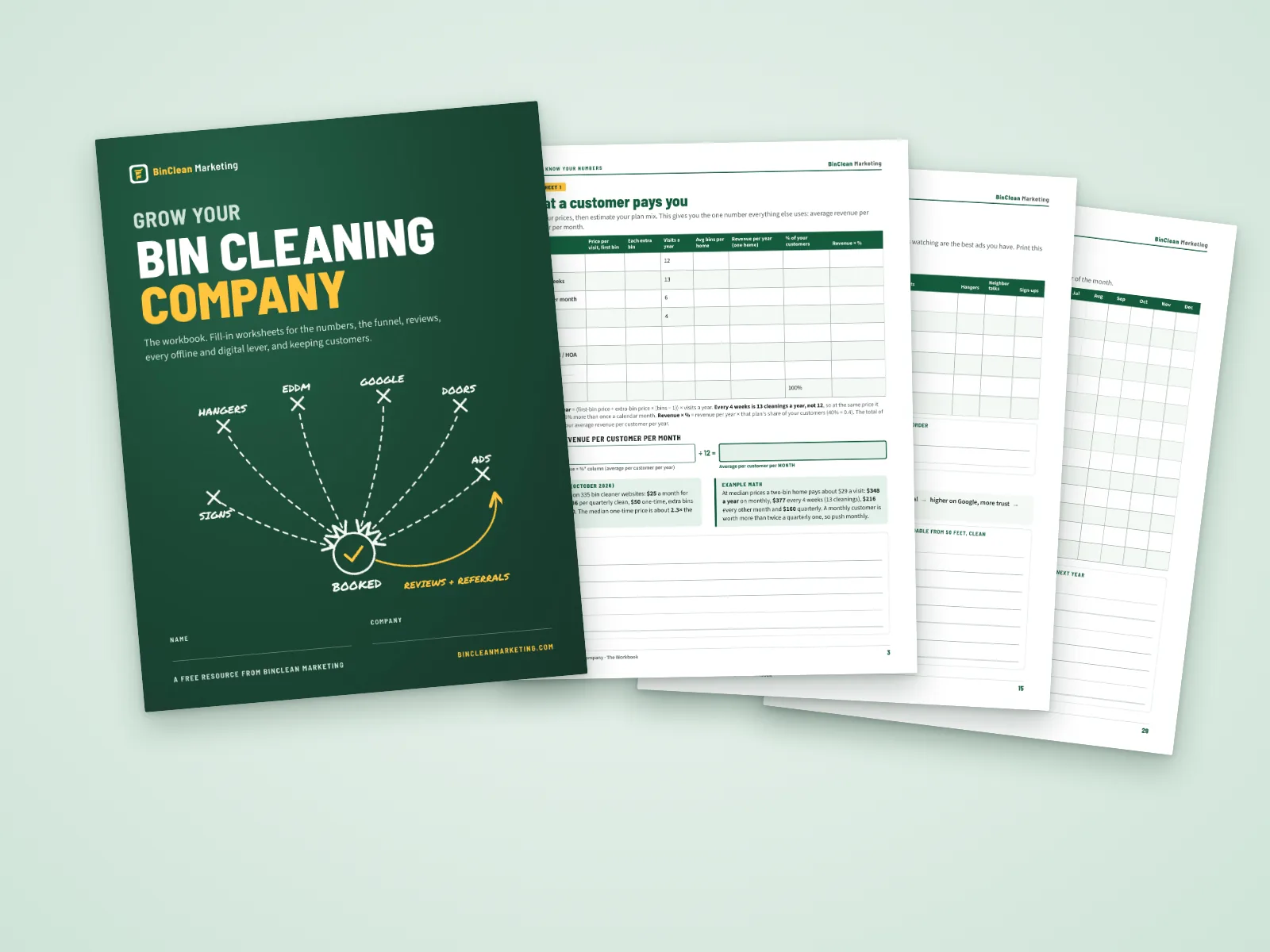
Free printable workbook: grow your bin cleaning company
New: 32 printable pages for your numbers, your funnel, reviews and every marketing lever. Free PDF, no email needed.
Read more →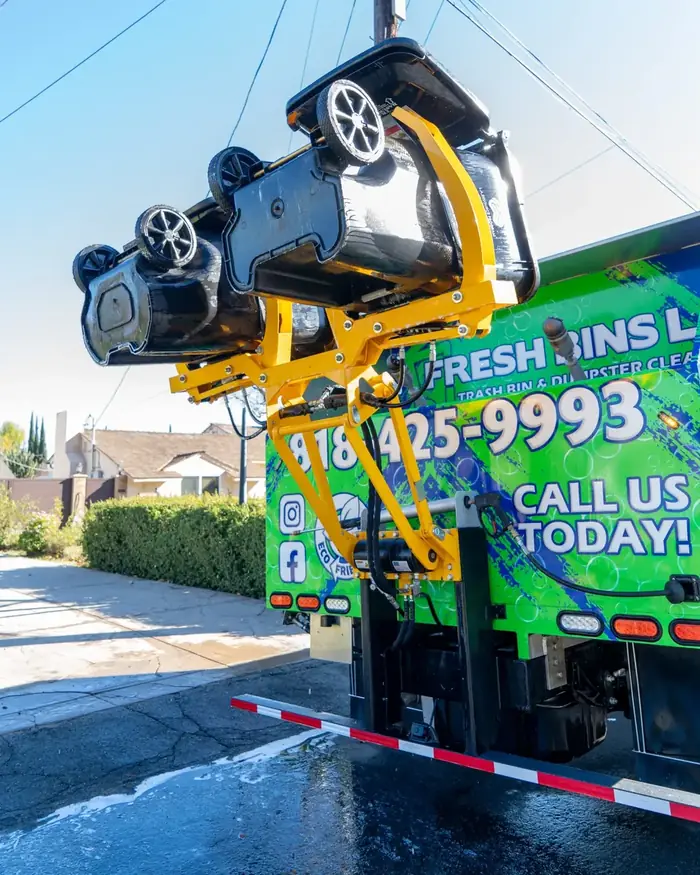
Google Ads for bin cleaning: real numbers
$41 in ads per new customer against a $117 first payment, and what made it work.
Read more →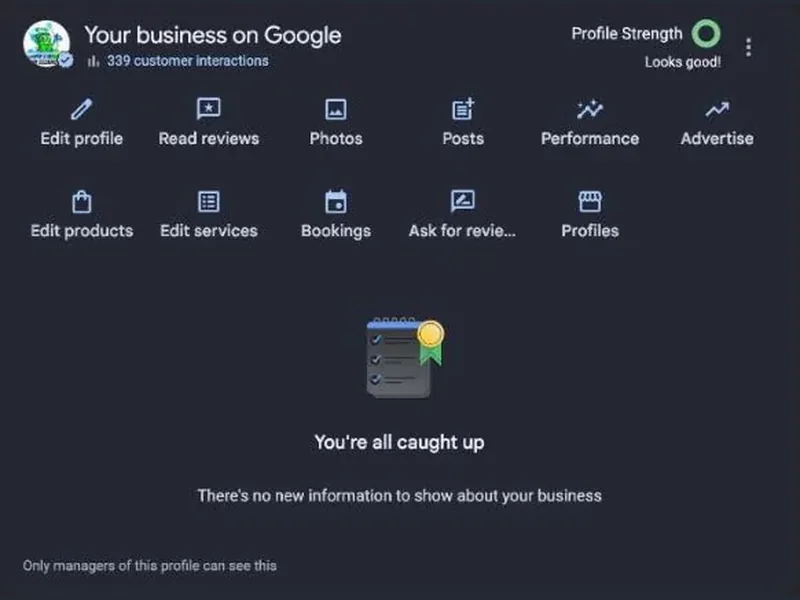
How to set up your Google Business Profile
Updated: every step with screenshots, from creating and verifying it to services, posts and reviews.
Read more →Questions
Common questions
What is the best way to market a bin cleaning business?
Build the funnel first: a complete Google Business Profile, a website with prices and online booking, and software that books on trash day and handles reminders and billing. Then fill it street by street: door hangers on the neighbors of every customer, cart stickers where allowed, EDDM around your routes, HOA deals, reviews from every customer, and Google Ads on “trash can” searches in your best ZIP codes, tracked to payments.
How do bin cleaning companies get customers?
Mostly from Google (the map and search results), neighbors who see the work and the rig, door hangers on route day, referrals, HOA and street deals, and ads. South Bay Bin Cleaners’ Google profile was viewed by 2,113 people from June to early November 2026 and led to 339 calls, texts and website clicks.
Do door hangers work for bin cleaning?
They work best on the neighbors of current customers, on cleaning day, with a before-and-after photo, your price and a QR code unique to that batch. There’s little published data; one cleaning business got two customers from 100 hangers. Blanketing a whole town is slow.
Is EDDM worth it for a bin cleaning business?
It can be, aimed at the mail routes around your current customers. EDDM Retail postage is $0.26 a piece, with no mailing list needed, for 200 to 5,000 pieces per ZIP code per day. Put prices, a before-and-after and a tagged QR code on it, mail the same routes two or three times a season, and stop mailing routes that bring nothing back.
Can I put stickers on customers’ trash cans?
Check first. In many cities the carts belong to the city or the hauler, and some cities limit markings to the house number. Ask the customer, keep it small and removable, never cover the cart’s labels or numbers, and use a hang tag if stickers aren’t allowed.
Can I put flyers in mailboxes?
No. Federal law (18 U.S.C. 1725) bars putting unstamped mail in a letterbox. Use doorknobs, or mail through USPS with EDDM.
How do I get more reviews for my bin cleaning business?
Ask every customer after their first cleaning, with your direct Google review link in the done text. Ask in person too, reply to every review, and never offer anything in exchange or ask only happy customers. Don’t ask for Yelp reviews at all.
How much should a bin cleaning business spend on marketing?
Start with what’s free: Google profile, reviews, referrals, route-day hangers. Then test paid channels small and judge each by cost per paying customer. Fresh Bins LA paid $41 per customer from Google Ads against a $117 average first payment, so the ads paid back on the first cleaning.
How do I keep bin cleaning customers from canceling?
Reminder texts before every cleaning, done texts with a photo, automatic card retries, self-service skips and pauses, a free re-clean when something goes wrong, and a clear term or a prepaid year. Win back one-time customers with a text about 75 days after their cleaning.
Book a demo
See how it works on a call.
Pick a time on Taylor’s calendar. We’ll look at your Google profile, website and booking setup with you, show you how Clean Bin System runs sign-ups, routes and billing, and tell you what we’d fix first. No cost, no pressure.
On the call
- Your Google profile and website, and what’s costing you bookings
- Clean Bin System: online sign-ups, routes built around trash day, and card billing that runs itself
- What it would cost you, and how soon you could be live